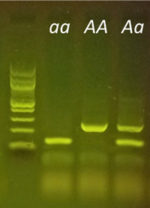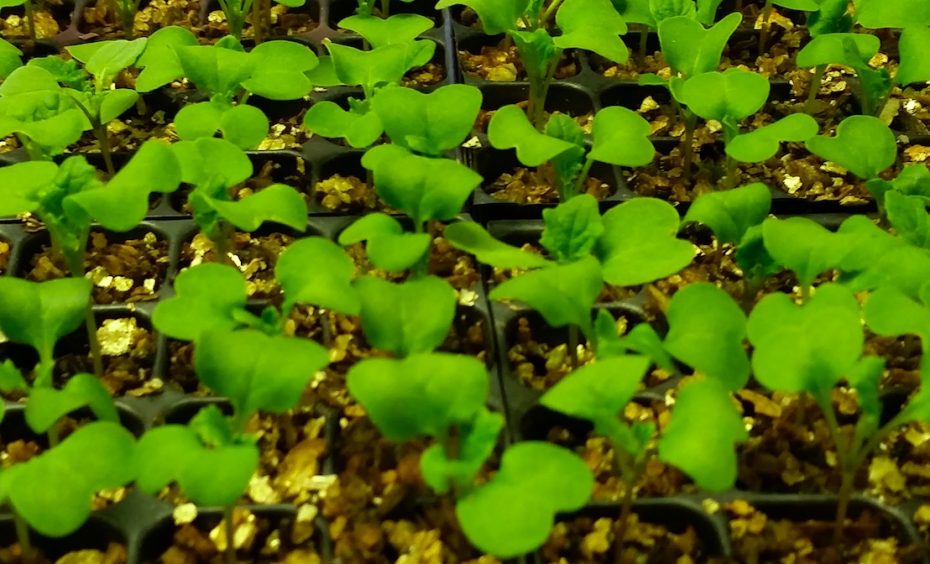
Student-centered Inheritance Investigation: Hands-on & High-rigor Inheritance and patterns of heredity are central to middle and high school science standards, but they can be hard for students to understand without chances to talk through evidence together. While case studies and pedigrees can introduce key ideas, students develop deeper understanding when they collect data, compare observations, and make sense of results as …
New! Polycots Fast Plants Seed Line: Engaging & versatile for selection experiments
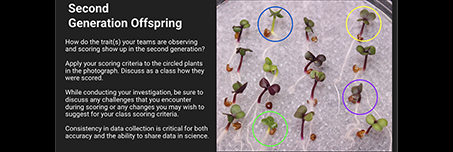
Polycot seedlings are easy to distinguish just a few days after germination! Our new Polycots seed line of Fast Plants features a trait that students can easily see at the seedling stage. In addition, we’ve developed a procedure for producing parental (Generation 1) and offspring (Generation 2) Polycot seed stocks, so it is not necessary for students to produce their own …
Inheritance and Genetics: Observing Variation and Measuring Selection in Fast Plants
Variation is a fundamental attribute of life; understanding its nature is important to all. Wisconsin Fast Plants are an ideal model for teaching this concept, with easily observable variation in many plant traits. This variation can be observed, described, and measured or quantified to gain greater understanding of plant traits. Development of selection experiments allows analysis of recorded data and measuring …
Counting Leaf Hairs on Fast Plants for Selection Experiments
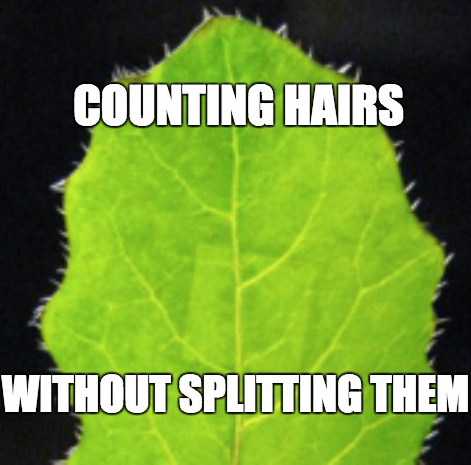
Hairs are not often a trait that we associate with plants. However, of all the traits that students might observe in a population of Fast Plants, we can learn a lot about variation and natural selection by counting and selecting for the number of hairs on a leaf margin. Selective breeding to increase (or decrease) hairiness can provide an excellent opportunity …