Browse Resources
Resources | |
|---|---|
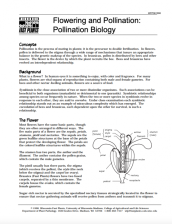 This pdf includes background information and an activity for engaging students in the processes that occur during pollination, fertilization and seed development in Fast Plants. Pollination is explained and illustrated and an activity for students to pollinate Fast Plants and observe reproductive...
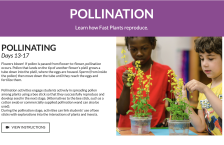 This webpage from the Fast Plants website explains how to pollinate Fast Plants, including instructions for making bee sticks and pollination videos and tips.
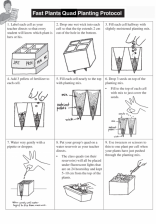 This document is the step-by-step instructions for planting Fast Plants in a quad growing system like is sold by Carolina Biological Supply Company. The instructions are illustrated by our Fast Plants artist, Amy, to help all learners understand the steps.
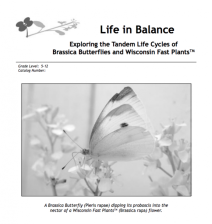 Download this complete unit of instructions to conduct an ecosystem inquiry. In this investigation, students have the opportunity to witness first-hand the dynamic relationship between Brassica butterflies and Wisconsin Fast Plants. Students are responsible for tending the butterflies and plants...
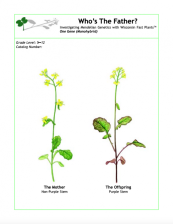 In this investigation, students will gather their own evidence to explain how inheritance works. As they observe three generations of Wisconsin Fast Plants, students will unravel a mystery of paternity: What is the father’s phenotype? Is it the same as the mother’s phenotype or the offspring’s...
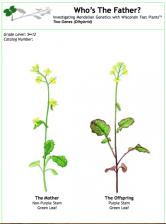 Download the complete instructions for a high school level inheritance and genetics inquiry, using Wisconsin Fast Plants. In this investigation, students gather their own evidence to explain how inheritance works. As they observe three generations of Wisconsin Fast Plants, students unravel a...
 This Immersion Unit provides a coherent series of lessons designed to guide students in developing deep conceptual understanding that is aligned with the National standards, key science concepts, and essential features of classroom inquiry (as defined by the National Science Education Standards)....
 Download this complete and coherently designed, middle school level unit to teach fundamental concepts that underpin the theory of evolution. The unit was collaboratively designed by teachers, college faculty & staff, and the Fast Plants Program at UW-Madison to support student-centered...
 This Immersion Unit provides a coherent series of lessons designed to guide students in developing deep conceptual understanding that is aligned with the standards, key science concepts, and essential features of classroom inquiry (as defined by the National Science Education Standards).
Unit...
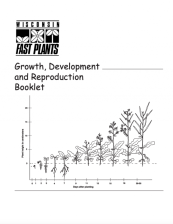 A 32-page booklet, containing complete instructions for activities at each life cycle stage. The booklet also includes important background information about plant physiology and how to grow Fast Plants. A Growth, Development and Reproduction kit is available. You can also conduct all the...
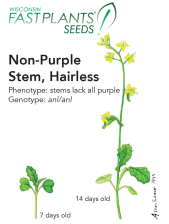 This is a page on the Fast Plants website, describing the Non-Purple Stem Hairless variety of Fast Plants (Brassica rapa). This page includes suggestions for investigations and teaching applications using this seed variety.
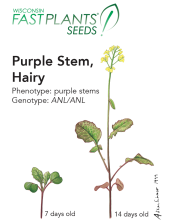 This is a page on the Fast Plants website, describing the Purple Stem, Hairy variety of Fast Plants (Brassica rapa). This page includes suggestions for investigations and teaching applications for using this seed variety.
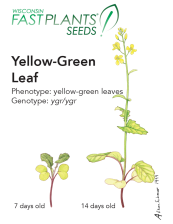 This is a page on the Fast Plants website, describing the Yellow-Green Leaf variety of Fast Plants (Brassica rapa). This page includes suggestions for investigations and teaching applications using this seed variety.
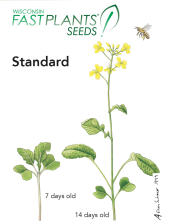 This is a page on the Fast Plants website, describing the Standard variety of Wisconsin Fast Plants (Brassica rapa). This page includes suggestions for investigations and teaching applications using this seed variety, including use as a model organism to teach about the plant life cycle and plant...
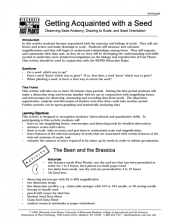 Description: In this activity students become acquainted with the anatomy and biology of seeds. They will use lenses and scales and make drawings to scale. Students will measure and calculate magnifications and they will begin to understand relationships among these. They will organize and summarize...
| |
| ← Previous | |