Space Seeds
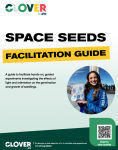
This free, 16-page downloadable PDF facilitation guide from 4-H offers hands-on experiments using Fast Plants to investigate how light and gravity influence seed germination and growth. Teachers will find structured activities, background information, and discussion prompts exploring phototropism, gravitropism, and microgravity, linking to real space research by aerospace engineer Emily Calandrelli. It aligns with MS-LS1-4 science standards, fosters scientific inquiry, and introduces plant science careers, making it an engaging resource for youth to explore biology and space exploration.
Title: SPACE SEEDS: A Facilitation Guide for Hands-on Plant Germination and Growth Experiments
Author/Creator: 4-H
Resource Type: Facilitation Guide, Activity Guide, Experiment Guide, Lesson Plan
Audience: Youth, Students, Facilitators, Educators, Mentors, 4-H Clubs
Summary/Abstract: This comprehensive facilitation guide provides instructions for conducting hands-on, guided experiments that investigate the effects of light and orientation (gravity) on the germination and growth of seedlings. Using Rapid Cycling Brassica rapa seeds (Wisconsin Fast Plants), participants will explore concepts of phototropism and gravitropism through a germination experiment and a gravitropism experiment. The guide connects these Earth-based activities to real-world scientific research, including experiments conducted in space by aerospace engineer Emily Calandrelli with Blue Origin and the U.S. Space Force, exploring plant growth in microgravity. It encourages scientific inquiry, observation, reflection, and discussion, fostering a growth mindset and highlighting career connections in plant science, genetics, ecology, and agriculture. Background information on seeds, germination, etiolation, phototropism, gravitropism, and microgravity is included, along with a glossary of key terms.
Learning Objectives/Outcomes:
- Observe and compare the effects of light and dark conditions on seed germination and seedling growth.
- Observe and compare the effects of orientation (gravity) on seedling growth direction.
- Understand how gravity and light influence plant development on Earth.
- Connect Earth-based plant experiments to the importance of plant science in space exploration and sustaining human life on long-term missions.
- Engage in the scientific process, including preparation, setup, observation, reflection, and discussion.
- Explore career paths in plant science and related fields (e.g., geneticists, ecologists, agricultural scientists).
- Develop a growth mindset and recognize its importance in scientific research.
Keywords/Tags: Space Seeds, Plant Growth, Germination, Seedlings, Fast Plants, Wisconsin Fast Plants, Rapid Cycling Brassica rapa, Light, Dark, Orientation, Gravity, Gravitropism, Geotropism, Phototropism, Etiolation, Microgravity, Space Exploration, Plant Experiments, Hands-on Science, STEM, Inquiry-Based Learning, Scientific Process, Observation, Scientific Reasoning, Empirical Evidence, Science Standards, 4-H, Youth Development, Emily Calandrelli, Blue Origin, NASA, Moon Trees, Plant Science Careers, Geneticists, Ecologists, Agricultural Scientists, Pollination, Seeds, Water, Oxygen, Temperature, Photosynthesis, Cellular Respiration, Embryo, Radicle, Hypocotyl, Cotyledons, Statocytes, Statoliths, Auxins, Chlorophyll, Seed Coat, Dicot, Matter, Energy, Science Education, Earth Science, Biology, Life Science, Experiential Learning.
Science Standards: Next Generation Science Standard MS-LS1-4 (Use argument based on empirical evidence and scientific reasoning to support an explanation for how characteristic animal behaviors and specialized plant structures affect the probability of successful reproduction of animals and plants respectively).
Related Concepts: Seed biology, plant physiology, plant adaptation, environmental factors, controlled experiments, data collection, critical thinking, problem-solving, agricultural innovation, sustainable food systems, space agriculture, life support systems in space.
Comments