
SLIDE 5:
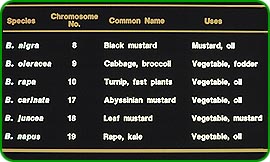
Some of the common names of the varieties within each species are given here, along with their uses.
At the top is Brassica nigra, popularly known as black mustard, which is a common noxious weed worldwide. It actually looks very much like the Wisconsin Fast Plants, but its seed will stay dormant in the soil for years, until the ground is disturbed (e.g. by a tractor or bulldozer) after which it is one of the first plants to put in an appearance as a weed.
Near the bottom of the list is Brassica juncea, which is the cross between Brassica rapa and Brassica nigra. Brassica juncea comprises the mustards. In the southern US, it is often eaten in the form of mustard greens. The distinctive flavor of mustard oil, present to some extent in all the brassicas, is strongest in the various types of B. juncea.
Mustard seeds contain mustard oils, or glucosinolates, which are activated by the saliva in our mouths and release the strong "mustard" flavor. These glucosinolates, found in all brassicas, are a help to both plants and humans. They confer some sort of selective advantage to the plants, such as repelling certain insects or attracting others. The strong flavor helps to discourage deer and rabbits from eating the brassica crops in the fields. In mammals, glucosinolates have been found to help detoxify cancer-causing nitrosamine chemicals in the liver.
Both Brassica juncea and Brassica napus, listed below it, are most important to the world in terms of the crop known as oilseed rape.